
Why Home Health and Hospice Deals Are Surging While Private-Duty and Medicaid Transactions Fall Behind
By M. Moses Shmueli | Northeastern Advisors
September 2026
The home-based care M&A market is back—but it is not coming back evenly.
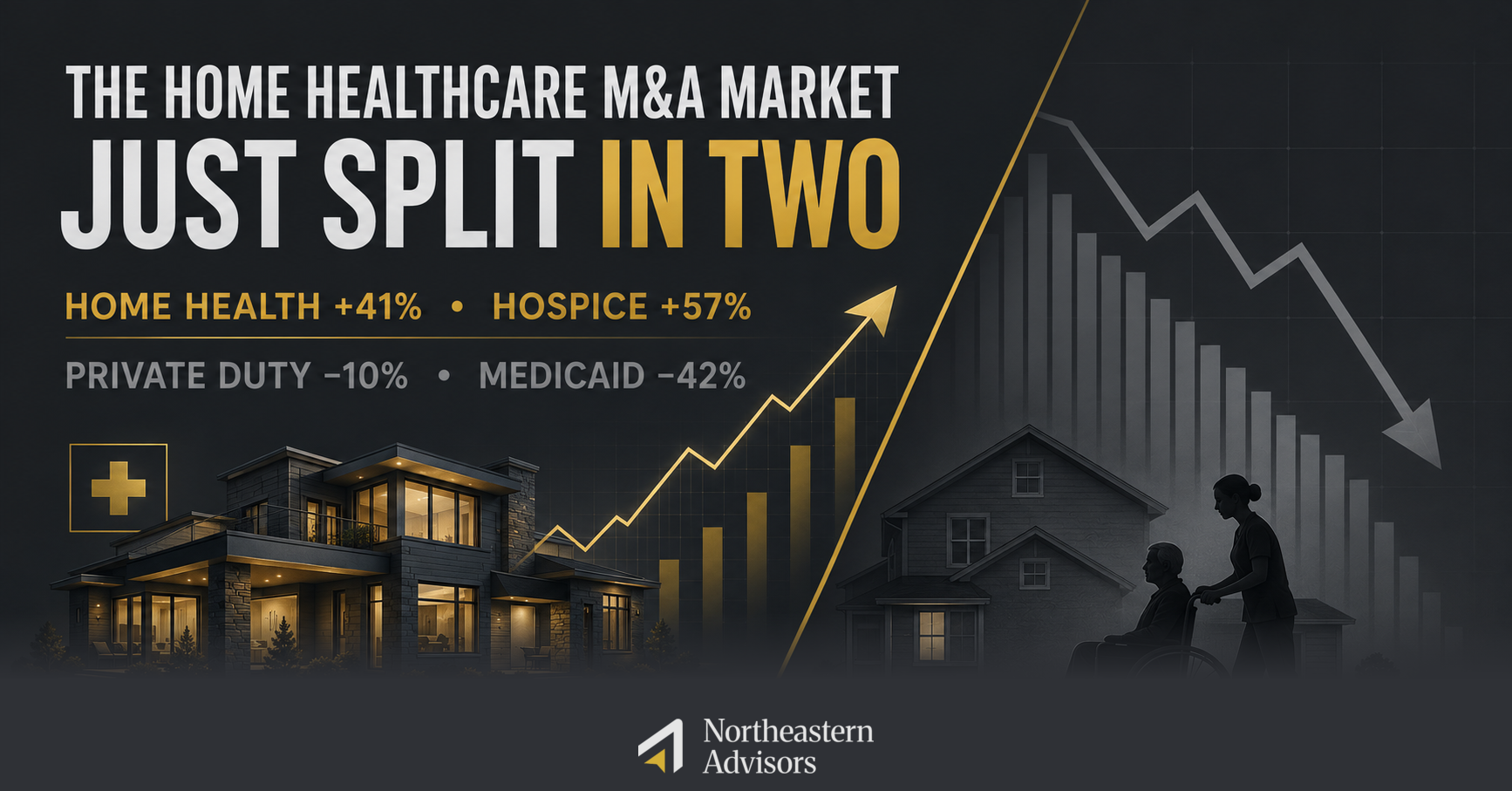
New first-half data reported in late August show a striking divide. On an annualized basis, certified home health transactions are projected to increase 41% in 2026, while hospice transactions are projected to rise 57%. At the same time, private-duty deal volume is projected to decline 10%, and Medicaid-focused transactions are projected to fall 42%.
That is not a routine market recovery. It is a repricing of risk across the home-based care continuum.
Buyers are still attracted to the same long-term fundamentals: an aging population, strong demand for care in the home, fragmented ownership and the opportunity to build regional density. But they are becoming far more selective about which reimbursement models, licenses and operating platforms deserve their capital.
For owners, the message is important: being in home-based care is no longer enough. The market is increasingly distinguishing between businesses that offer scarce regulatory access and predictable reimbursement—and those whose margins and growth depend on more difficult state programs, labor models or payer dynamics.
The Numbers Behind the Recovery
According to first-half data from The Braff Group reported by Home Health Care News on August 25, annualized 2026 transaction volume across certified home health, hospice, private duty and Medicaid home care is projected to reach 134 deals, up 12.6% from 119 transactions in 2025.
The headline sounds broadly positive. The underlying numbers tell a more consequential story:
- Certified home health: 48 projected transactions, up 41%
- Hospice: 44 projected transactions, up 57%
- Private duty: projected transaction volume down 10%
- Medicaid: projected transaction volume down 42%
These figures are annualized projections based on first-half activity—not completed full-year results. Still, the directional change is significant after four consecutive years of declining home health and hospice deal activity.
The market is not simply reopening. Capital is concentrating.
Why Certified Home Health and Hospice Are Moving First
Three forces appear to be driving buyer interest.
1. Reimbursement has become more predictable
Home health operators entered 2026 under substantial reimbursement pressure. CMS initially proposed a 6.4% Medicare payment reduction for 2026 before finalizing a more limited 1.3% aggregate decrease.
The proposed 2027 rule is materially more constructive. CMS estimates that aggregate Medicare payments to home health agencies would increase by approximately 2.4%, or $420 million, compared with 2026. The proposal still includes a 3.0% temporary behavioral adjustment, so it is not an uncomplicated windfall. But the absence of another proposed permanent adjustment has given buyers a more stable foundation for forecasting cash flow.
In M&A, certainty often matters almost as much as growth. A buyer can price known pressure. It is much harder to price an open-ended reimbursement threat.
2. The Medicare enrollment moratorium has made existing providers scarcer
CMS imposed a six-month nationwide moratorium on new Medicare enrollment for home health agencies and hospices effective May 13, 2026. The moratorium applies to initial applications and certain non-exempt changes in majority ownership, and CMS may extend it in additional six-month increments.
The policy was designed to combat fraud, waste and abuse—not to stimulate M&A. Yet it has an important transaction-market consequence: buyers seeking entry into a new geography may have fewer viable paths to build from scratch.
When new enrollment is restricted, an established, compliant and transferable Medicare provider number can become a scarcer strategic asset. That can increase interest in existing agencies, particularly in attractive markets where de novo entry is temporarily constrained.
However, owners should not assume that every change-of-control structure will be permitted. The moratorium itself can affect transaction structure, timing and regulatory approval. Buyers and sellers need qualified regulatory counsel early—before they agree to a structure that cannot close as intended.
3. Scaled buyers are still willing to deploy meaningful capital
Recent large transactions demonstrate that institutional buyers remain committed to high-quality home-based care platforms. General Atlantic’s reported $3 billion acquisition of TEAM Services Group and Kinderhook Industries’ approximately $1.1 billion take-private of Enhabit showed that capital is available for businesses with scale, infrastructure and a credible growth thesis.
Those transactions do not establish a valuation benchmark for smaller agencies. They do, however, reinforce a broader point: buyer appetite has not disappeared. It has become more discriminating.
Why Private-Duty and Medicaid Deal Activity Is Lagging
The decline in projected private-duty and Medicaid transaction volume does not mean those businesses are unsellable or strategically unattractive. Many remain compelling acquisition candidates. But buyers often underwrite them against a different set of risks:
- caregiver recruitment, retention and overtime exposure;
- state-by-state reimbursement pressure;
- minimum-wage increases that outpace rate adjustments;
- concentration in a limited number of Medicaid programs or managed-care organizations;
- uncertainty around authorization levels and rate resets;
- electronic visit verification, billing and compliance exposure; and
- limited ability to pass rising labor costs through to payers.
These issues can compress margins and make future EBITDA harder to forecast. They can also create a wider gap between a seller’s historical results and the earnings a buyer is willing to capitalize.
This is where the split in transaction volume matters. A decline in deal count does not necessarily mean there are no buyers. It may mean fewer companies are entering the market fully prepared, fewer are meeting institutional underwriting standards, or valuation expectations have not adjusted to the risk buyers now see.
What This Means for Home Healthcare Owners
The August data support five practical conclusions.
1. Sector momentum will not rescue a weak business
Rising home health and hospice deal volume may create more buyer conversations, but it will not cure poor documentation, compliance deficiencies, referral concentration or earnings that cannot survive diligence.
2. Medicare certification may be more valuable—but only if it is clean
Scarcity can increase strategic interest. It can also intensify scrutiny. Buyers will examine enrollment history, ownership changes, survey results, billing patterns, referral relationships and any facts that could threaten continued participation.
3. Quality of earnings will increasingly drive the price
In this market, buyers are likely to focus less on reported EBITDA and more on transferable EBITDA: earnings that remain after normalizing owner compensation, labor costs, reimbursement changes, one-time items and unsupported adjustments.
The businesses that command the strongest outcomes will be those that can demonstrate both historical profitability and a defensible path to future cash flow.
4. Transaction structure matters earlier than many sellers realize
Under an active enrollment moratorium, buyers and sellers should evaluate regulatory feasibility before treating an LOI as a largely economic document. Asset sale versus equity sale, ownership percentages, Medicare enrollment consequences, state licensing requirements and closing conditions may determine whether a transaction is executable at all.
5. Private-duty and Medicaid owners need a sharper equity story
Owners in the slower segments should not attempt to market themselves as generic home-care companies. They need to show buyers exactly why their platform is different: superior caregiver retention, attractive state reimbursement, diversified payer relationships, strong density, low client concentration, differentiated recruiting, clean compliance and proven organic growth.
In a selective market, specificity creates value.
The Northeastern Advisors View
The most important development in home healthcare M&A this August is not simply that deal volume is rising. It is that the recovery is becoming increasingly segmented.
Certified home health and hospice are benefiting from greater payment visibility, constrained new enrollment and continued institutional demand. Private-duty and Medicaid businesses face a more demanding underwriting environment in which labor economics, state reimbursement and compliance execution carry greater weight.
For strong operators, this can be an attractive market. But the window is not equally open for everyone—and the difference between receiving interest and achieving a premium outcome will often be determined months before a company is formally presented to buyers.
Owners considering a transaction in the next 12 to 24 months should begin with three questions:
- Which buyer universe is most likely to value our payer mix, geography and service model?
- Which risks will a buyer use to reduce price or shift consideration into an earnout?
- What can we fix now—before diligence converts a manageable issue into negotiating leverage for the buyer?
The home healthcare M&A market is moving again. The opportunity belongs to owners who understand which market they are actually in—and prepare accordingly.
Considering the sale, recapitalization or acquisition of a home healthcare business? Northeastern Advisors combines AI-native M&A technology with three decades of senior dealmaking experience to help owners and acquirers identify the right counterparties, position opportunities effectively and navigate complex transactions from strategy through closing.
Contact Northeastern Advisors for a confidential discussion.
This article is for informational purposes only and does not constitute legal, regulatory, tax or investment advice. Parties should consult qualified advisers regarding their particular circumstances.