
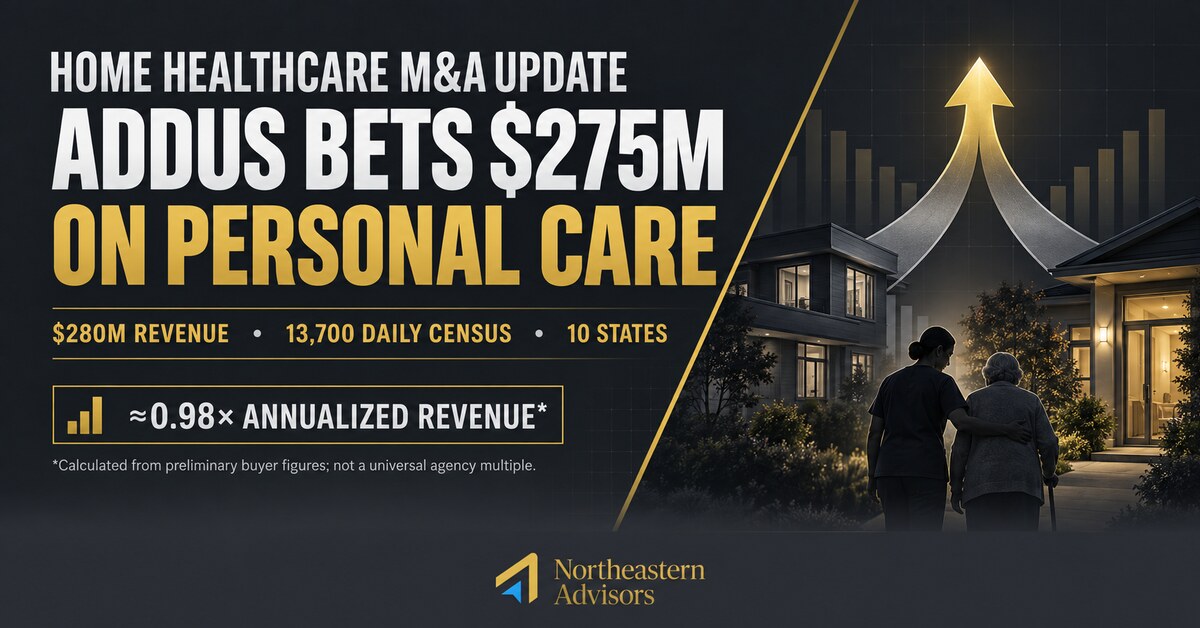
The Addus–AccentCare personal care acquisition is the clearest recent evidence that strategic buyers will still deploy substantial capital into home care when an asset offers scale, geographic density and a meaningful multi-state operating platform.
Addus HomeCare has agreed to acquire AccentCare’s personal-care operations outside New York for approximately $275 million. For owners, buyers and investors following home care M&A, the transaction provides both a useful valuation signal and a warning against applying headline multiples too broadly.
The deal also provides a useful public valuation signal—but one that requires careful interpretation.
The disclosed transaction facts
According to Addus, the acquired operations generate approximately $280 million in annualized personal-care revenue and serve an average daily census of approximately 13,700 customers through locations in ten states.
The acquisition will significantly expand Addus in Texas, Illinois, California, and Arizona. It also adds operations in Colorado, Georgia, Minnesota, Pennsylvania, Tennessee, and Washington.
AccentCare’s home-health and hospice businesses are not included. Its New York personal-care operations are also excluded. Addus expects to finance the acquisition with cash on hand and its revolving credit facility. The transaction remains subject to regulatory approvals and customary closing conditions. No expected closing date was disclosed. Addus transaction announcement
The revenue multiple is approximately 0.98x—but it is not a universal comparable
Dividing the anticipated $275 million purchase price by the buyer’s estimate of $280 million in annualized revenue produces a ratio of approximately 0.98x.
That calculation is straightforward. Its application is not.
Addus did not disclose the acquired business’s EBITDA, normalized margin, working capital, payer concentration, purchase-price allocation, contingent consideration, or expected synergies. The annualized revenue estimate is preliminary, and the purchase price remains subject to customary adjustments.
The business is also a large corporate carve-out. A ten-state operation serving approximately 13,700 customers is not directly comparable to a founder-owned agency operating in one market.
For a smaller home-care business, value will still depend on normalized EBITDA, payer mix, reimbursement durability, caregiver availability, state density, referral concentration, compliance, and the owner’s role. The public ratio is best viewed as evidence of strategic appetite for scale—not proof that all personal-care companies are worth roughly one times revenue.
Why the carve-out structure matters
AccentCare is retaining its home-health and hospice operations and its New York personal-care business. That boundary illustrates an important transaction principle: buyers may want a specific service line and geographic footprint rather than an entire enterprise.
A carve-out can create value when the selected business has distinct customers, payer contracts, employees, leadership, licenses, and financial reporting. It can also create execution risk when systems and costs are shared.
Buyers evaluating a carve-out should identify:
- Which employees and caregiver relationships transfer
- Whether licenses and Medicaid enrollments can be assigned or continued
- Which managed-care contracts require consent
- How EVV, scheduling, payroll, billing, and clinical data will migrate
- Which corporate costs are truly avoidable
- Whether transition services are required
- How working capital and pre-closing liabilities will be allocated
Sellers should prepare standalone financials before launching a process. Allocated overhead does not necessarily equal the cost a buyer will incur after closing.
State-by-state execution will determine timing
The acquired operations span ten states, each with its own licensing, Medicaid, managed-care, labor, EVV, and change-of-ownership requirements.
That means regulatory approval is not one line on a closing checklist. The parties need a jurisdiction-by-jurisdiction critical path. A delayed enrollment, payer consent, or data transition in one state can affect closing structure and working capital even when the broader strategic logic is sound.
This point is especially important while federal and state enrollment restrictions remain active. CMS’s nationwide home-health and hospice moratorium is not directly a personal-care rule, but diversified companies may have multiple provider types and enrollment dependencies. Transaction teams should map each legal entity, service line, and provider number independently.
Reimbursement precision is becoming more important
Two recent reimbursement developments reinforce the need for location-specific modeling.
First, CMS acknowledged a technical error in the FY 2027 hospice wage index. CMS recalculated values for every CBSA and rural area, requiring updates to national payment rates for all levels of hospice care. As of September 14, the correction notice had not been posted. Hospice buyers and sellers should treat models based on the July final-rule tables as provisional. CMS hospice announcement
Second, CMS approved a Utah Medicaid amendment that updates home-health and personal-care fee methodologies. A 1.75 personal-care multiplier applies to qualifying rural travel of 50 miles or more. It is not a statewide 75% increase. Buyers must validate mileage and claim eligibility before treating it as recurring revenue. Utah SPA
These are different programs, but the transaction lesson is the same: headline reimbursement changes must be translated into provider-specific collections.
Labor growth is encouraging, but buyers will look for company-level proof
The Bureau of Labor Statistics reported that home-health-care services added approximately 11,000 jobs in August. That is a positive capacity signal, but the data are preliminary and do not demonstrate lower turnover or wage pressure at a particular agency. BLS Employment Situation
Sellers can make the labor story more credible by documenting filled hours, caregiver retention, overtime, wage rates, referral acceptance, and census growth. Buyers will want to see whether additional staffing converts into revenue and margin.
Frequently asked questions about the Addus–AccentCare transaction
How much is Addus paying for AccentCare’s personal-care division?
Addus announced an anticipated purchase price of approximately $275 million, after customary purchase-price adjustments. The transaction has not closed.
What revenue multiple does the transaction imply?
Using Addus’s preliminary estimate of approximately $280 million in annualized revenue, the anticipated price implies approximately 0.98x revenue. This is an NEA calculation, not a buyer-disclosed multiple.
Does the transaction establish a valuation benchmark for personal-care agencies?
No. The acquired business is a large ten-state corporate carve-out. Addus did not disclose EBITDA, normalized margin, working capital, synergies or purchase-price allocation. Smaller agencies require company-specific analysis.
Which AccentCare businesses are excluded?
AccentCare is retaining its home-health and hospice operations and its New York personal-care operations.
What the Addus–AccentCare deal means for home care business owners
The Addus–AccentCare transaction supports three conclusions.
First, scaled personal-care platforms remain strategically relevant. Second, separable service lines can attract focused buyers. Third, a headline revenue ratio is only the beginning of valuation analysis.
Owners considering a sale should prepare state-level financials, normalize standalone costs, document payer and caregiver performance, and identify every regulatory approval required before closing. Buyers should combine that work with claim-level reimbursement testing and a realistic integration plan.
The market is rewarding scale, but it is also rewarding certainty. In home care, certainty comes from financial quality, regulatory continuity, defensible reimbursement, and an operation that can perform after ownership changes.
For confidential guidance on preparing, valuing, or acquiring a home-health, hospice, or personal-care business, contact Northeastern Advisors.
Receive future Home Healthcare M&A Updates:
https://northeasternadvisors.com/home-healthcare-ma-weekly-update/
This article is for general informational purposes and does not constitute legal, tax, accounting, lending, or investment advice.