

When potential buyers evaluate your business, one metric stands out as a critical risk indicator: customer concentration. If a significant portion of your revenue depends on just a few clients, acquirers view your company as vulnerable. A single lost relationship could destabilize cash flow, making your business a higher-risk investment. This perception directly translates into lower valuations, more restrictive deal terms, and potentially fewer interested buyers.
Customer concentration risk represents the financial exposure created when your revenue streams lack adequate distribution across your client base. Buyers conducting due diligence scrutinize this factor intensely, often applying valuation discounts or structuring earnouts to protect themselves against post-acquisition revenue loss.
Diversifying your customer base serves as a strategic lever to mitigate these concerns. By building a broader, more balanced portfolio of clients, you demonstrate resilience, reduce perceived risk, and position your business for a more favorable valuation when the time comes to exit.
Understanding Customer Concentration Risk
Customer concentration risk refers to the vulnerability created when a business generates a large portion of its revenue from one or a few clients. This revenue dependency becomes problematic when a single customer accounts for more than 10-15% of total revenue, although the specific thresholds may vary depending on the industry and business model.
How Customer Concentration Risk Manifests
This risk can manifest in several ways:
- A manufacturer supplying 40% of its output to one automotive client faces immediate cash flow disruption if that contract terminates.
- A software company serving three enterprise clients representing 65% of annual recurring revenue operates under constant pressure to maintain those relationships at any cost, often sacrificing margin and strategic flexibility.
Real-World Examples of Customer Concentration Risk
Real-world vulnerabilities can arise quickly:
- When a regional distributor lost its largest client—representing 35% of revenue—to an acquisition by a competitor with in-house distribution, the business faced immediate liquidity constraints and laid off 20% of its workforce within sixty days.
- The subsequent sale process revealed that M&A risk mitigation concerns led potential buyers to apply valuation discounts exceeding 30%, viewing the remaining customer base as equally unstable.
The Direct Impact of Customer Concentration on Business Valuation
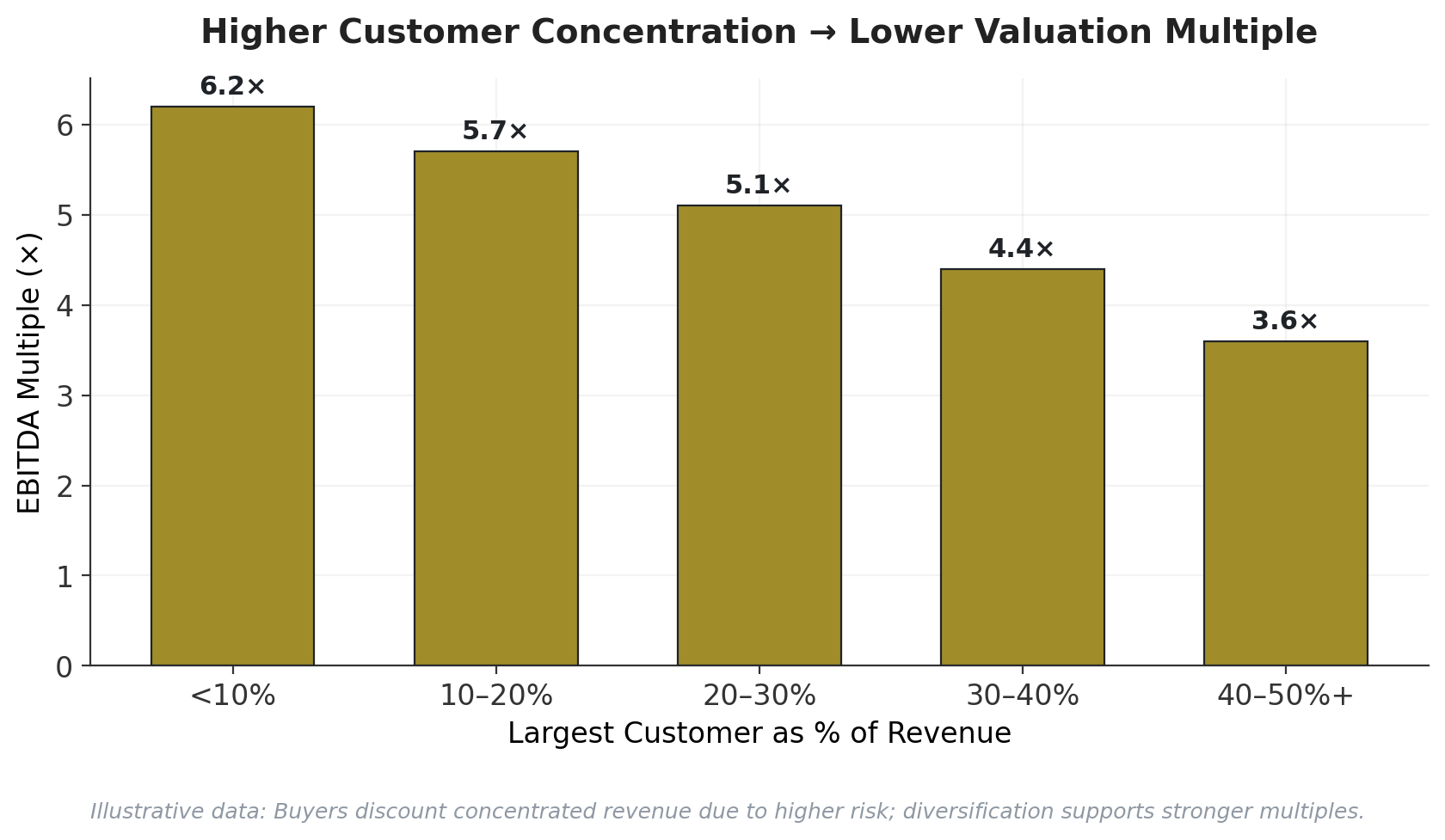
When buyers conduct their business valuation methods and buyer risk assessment, customer concentration immediately triggers red flags that translate into tangible financial consequences. A company deriving 40% or more of its revenue from a single client typically faces valuation discounts ranging from 20-40%, depending on the severity of the concentration and industry dynamics.
Discounted cash flow analysis becomes particularly challenging with concentrated revenue streams. Buyers apply higher discount rates to future cash flows, reflecting the elevated probability that losing a major customer could devastate earnings. A company projecting $2 million in annual EBITDA might see its multiple compressed from 5.5x to 3.5x solely due to customer concentration concerns.
Market multiples suffer similar compression. Acquirers compare your business against industry benchmarks, and concentrated customer bases consistently command lower EBITDA multiples. Strategic buyers may offer reduced earnouts or implement longer escrow periods to hedge against customer attrition post-acquisition. Private equity firms often require seller financing or rollover equity to share the concentration risk, fundamentally altering deal economics and reducing upfront cash proceeds. Buyers evaluate customer concentration alongside other core valuation factors such as owner dependency — a topic explored in depth in our article on reducing owner dependency to increase business valuation.
Strategic Advantages of a Diverse Customer Base Beyond Just Valuation
Diversifying your customer base to reduce risk when selling a business extends far beyond the immediate impact on purchase price. A well-distributed revenue stream creates operational advantages that strengthen your company’s fundamental performance and market position.
Enhanced Financial Predictability
Businesses with varied clientele experience more consistent cash flow patterns. When revenue sources span multiple industries, geographic regions, or customer types, seasonal fluctuations and industry-specific downturns affect only portions of your income statement. This stability allows for more confident capital allocation decisions and strategic investments in growth initiatives.
Resilience Against Economic Downturns
A market segmentation strategy that targets different customer profiles provides natural hedging against economic volatility. While certain sectors may contract during recessionary periods, others often remain stable or even expand. Companies serving healthcare, essential services, and government sectors alongside discretionary consumer markets demonstrate lower risk exposure through this balanced approach.
Implementing Effective Market Segmentation
Strategic diversification requires deliberate planning:
- Analyze existing customer data to identify underserved segments with similar needs to your current offerings
- Develop targeted value propositions that address specific pain points for each segment
- Test market entry strategies with controlled pilot programs before full-scale expansion
- Monitor performance metrics by segment to optimize resource allocation
This methodical approach to customer diversification builds organizational resilience while positioning your business as a lower-risk acquisition target for sophisticated buyers evaluating long-term sustainability.
Adapting Your Offerings for a Diverse Customer Base
Serving multiple customer segments requires a commitment to innovation in product development that keeps pace with distinct market demands. Each segment brings unique requirements, pain points, and purchasing behaviors that necessitate tailored solutions rather than one-size-fits-all approaches.
Successful adaptation begins with establishing feedback mechanisms across all customer segments. Regular surveys, customer advisory boards, and direct engagement channels provide the intelligence needed to identify emerging needs before competitors do. This proactive stance enables businesses to refine existing offerings and develop new solutions that resonate with specific segments while maintaining operational efficiency.
Examples of Successful Adaptation
- A regional manufacturing company demonstrated this principle by serving both automotive and medical device industries. When automotive demand softened, they leveraged their precision capabilities to develop specialized components for medical applications. The investment in cleanroom facilities and ISO 13485 certification opened an entirely new revenue stream while utilizing existing technical expertise.
- Similarly, a B2B software provider expanded from serving mid-sized retailers to enterprise clients by creating modular product tiers. The core platform remained consistent, but configurable features addressed the complexity requirements of larger organizations without alienating their original customer base. This approach preserved development resources while capturing higher-value contracts.
The key lies in identifying transferable capabilities within your organization that can be reconfigured or enhanced to serve adjacent markets. This strategic flexibility transforms customer diversification from a defensive measure into a growth catalyst.
Practical Steps to Start Diversifying Your Customer Base Today
1. Conduct a Market Gap Analysis
Begin by examining your current customer portfolio to identify patterns in industry, geography, and revenue contribution. Map out adjacent market segments that share similar pain points but operate in different sectors or regions. For businesses in competitive markets like New York, this analysis reveals untapped opportunities within your existing service capabilities.
2. Develop Targeted Outreach Campaigns
Create segment-specific value propositions that address the unique challenges of each new market. A manufacturing company serving automotive clients, for example, might discover their precision capabilities translate well to medical device manufacturers. Craft messaging that speaks directly to these prospects’ operational concerns rather than repurposing generic marketing materials.
3. Leverage Digital Channels for Scalable Reach
Deploy LinkedIn advertising campaigns targeting decision-makers in your identified segments. Establish thought leadership through industry-specific content that demonstrates expertise beyond your current client base. Email nurture sequences can educate prospects on how your solutions address their particular challenges.
4. Build Strategic Partnerships
Identify complementary service providers who already serve your target segments. A software company might partner with implementation consultants who work across multiple industries, gaining introductions to qualified prospects. These relationships provide credibility and accelerate market entry without significant capital investment.
5. Test and Validate Before Scaling
Launch pilot programs with 2-3 clients in each new segment to refine your approach. Document case studies that demonstrate measurable results, creating proof points for broader market penetration.
Case Study: A Successful Business Sale Fueled by Customer Diversification
A specialty manufacturing company in the Midwest provides a compelling real-world example of business sale success through diversification benefits. The company generated $12 million in annual revenue, with 65% coming from a single automotive client when the owner began planning his exit strategy in 2018.
Identifying the Problem
The owner recognized that having such a large portion of revenue coming from one client created a valuation penalty for the business. If anything were to happen to that client or if they decided to take their business elsewhere, it would significantly impact the company’s financial health and attractiveness to potential buyers.
Implementing a Diversification Plan
To address this issue, the owner implemented a three-year diversification plan aimed at reducing reliance on the automotive industry and expanding into adjacent sectors. The targeted industries included:
- Aerospace
- Medical devices
- Industrial equipment manufacturers
By actively pursuing opportunities in these markets, the company aimed to increase its customer base and decrease the percentage of revenue generated by the automotive client.
Measuring Success
By 2021, the results of the diversification efforts were evident. The largest customer now accounted for only 28% of revenue, while the top five clients collectively represented 55% of total sales. This shift not only improved the company’s financial stability but also made it more appealing to potential buyers.
The Transformation Results
The impact of customer diversification on the business’s valuation and sale prospects was significant:
- Valuation multiple increased from 3.8x EBITDA to 5.2x EBITDA
- Number of qualified buyers expanded from two initial interested parties to seven competitive bidders
- Deal structure improved with 85% cash at close versus initial offers of 60-65%
- Earnout period reduced from 36 months to 18 months due to decreased buyer risk perception
Critical Lessons from the Journey
Throughout this journey, there were important lessons learned that can benefit other business owners considering similar strategies:
- Maintain profitability discipline: While it’s tempting to take on any work that comes your way in order to diversify revenue sources, it’s crucial to stay true to your profitability goals. Accepting low-margin projects can erode overall profitability and undermine future growth prospects.
- Plan for higher customer acquisition costs: When expanding into new industries or markets, it’s common for customer acquisition costs (the expenses associated with acquiring new customers) to exceed initial projections. It’s important to factor this into your financial planning and ensure you have sufficient working capital available.
- Be prepared for operational adjustments: Diversification often requires changes in operations such as obtaining different quality certifications or adapting production processes. These adjustments can take longer than expected but are necessary for meeting customer requirements and maintaining competitiveness.
The strategic patience exhibited by the owner paid off when a private equity buyer expressed interest in acquiring the business. This particular buyer was willing to pay a premium due to the established, diversified customer foundation that reduced integration risk and provided multiple avenues for growth.
This case study serves as a reminder of the power of diversification in enhancing business value and attracting potential buyers. By proactively addressing concentration risks through strategic expansion efforts, companies can position themselves favorably in an increasingly competitive marketplace.
Conclusion
Customer concentration is a major obstacle to getting the best price when selling your business. Evidence shows that buyers often see companies with a small number of clients as risky and lower their offers accordingly.
To overcome this vulnerability, you need a business valuation optimization strategy that addresses customer concentration. The most valuable companies have one thing in common: they generate revenue from multiple customers, with no single client posing a threat to their operations. By diversifying your customer base, you can transform your business from high-risk to attractive in the eyes of potential buyers.
Diversifying your customer base takes time—usually 18 to 36 months—to show sustainable patterns. Business owners who start this process early, well before they plan to sell, can create measurable value that directly increases the sale price. On the other hand, those who wait until they are already talking to potential buyers will find it difficult to fix customer concentration issues during the sale process.
Schedule a Confidential Consultation Today!
At Northeastern Advisors, we work with business owners every day to identify customer concentration risks and position their companies more favorably in the eyes of buyers. We analyze revenue distribution, develop diversification strategies, and structure financial presentations that reduce perceived risk and support stronger valuation multiples. Because we negotiate with strategic buyers and private equity firms on a regular basis, we know precisely how concentration impacts deal terms — and how to mitigate those concerns before going to market.
If you’d like to understand how customer concentration affects your company’s valuation today, we offer a confidential, no-cost preliminary valuation review to help you assess your position and plan a path toward a stronger exit.
Contact us at us@northeasternadvisors.com or visit our Sellers page to learn how we can help you prepare for a profitable and seamless exit.

Build, License, Merge or Do Nothing: The Technology Decision Facing Independent Law Firms
Rapid technological change is forcing independent law firms to choose: build their own technology, license it, merge with a larger platform or do nothing. Here is how each path affects costs, talent and valuation.

Deaconess Closes HCA’s 31-Location Sale: What It Means for Home Health and Hospice M&A
Deaconess’s acquisition of 31 HCA home health and hospice locations highlights strategic demand for scale, multistate platforms, and carve-out readiness.

Law Firm MSOs: How Private Equity Is Investing in Law Firms
Private equity is moving into the legal industry through law firm MSOs. Here is what investors acquire, how owners obtain liquidity and where the legal boundaries remain.

Legal Services M&A: AI Acquisitions, MSO Expansion and New Ownership Models
Legal services M&A is accelerating across AI infrastructure, MSO platforms and alternative ownership models. See what the latest transactions mean for buyers, investors and law firm owners.

New SBA Acquisition Rules October 2026: What Buyers and Sellers Need to Know
New SBA acquisition rules effective October 1, 2026 raise DSCR, financial diligence, valuation and equity requirements. What buyers and sellers should know.

New SBA Citizenship Rules Can Block an Otherwise Financeable Acquisition
New SBA citizenship rules can block an otherwise financeable acquisition. What buyers and sellers should check before committing to exclusivity and diligence.