Selling to a private equity-backed platform rarely looks like the horror stories, but owners deserve a straight answer about what actually changes and what doesn’t.
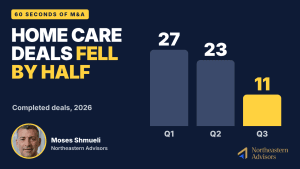
60-Second Explainer
General information only, not legal, tax or financial advice.
The Two-Line Email That Says Everything
A few weeks ago I sent a short follow-up note to the owner of a family-run home care agency in the Southeast. Nothing fancy: a mention that partnering with an established operator could bring growth capital, back-office support, or a gradual ownership transition.
The reply came back in two lines. No “not interested.” No “how much?” She simply asked me to spell out, in detail, what a partnership with an established home care company would actually look like.
That question is the one almost every owner is quietly asking. They have spent ten or twenty years building something. They have caregivers who have been with them since the early days and clients whose families know them by first name. When someone uses the word “partnership,” they want to know what it really means before they spend a single hour on a call.
So here is the honest version of the answer I sent, expanded for every owner who has wondered the same thing.
Who Is Actually on the Other Side of the Table
In most cases the “established operator” is a home care platform backed by private equity. The firm buys a strong first agency, then adds well-run agencies in nearby markets and builds a regional or national company on one shared back office.
That model has one big implication for you: the buyer needs your agency to keep working the day after closing. They are not buying a building or a piece of equipment. They are buying your caregivers, your client relationships, your referral sources and your reputation. Every one of those walks out the door if the transition is handled badly.
That is why the better platforms talk so much about continuity. Keeping the team in place, keeping the local name and keeping the owner involved is not charity. It protects the value they are paying for. In practice, many of them would rather buy from an owner who wants to stay than from one who wants to leave the week after closing.
“Partnership” Usually Means One of Three Structures
There is no single template. The structure follows your goals, and most deals land in one of three shapes.
| Structure | What happens | Your role after closing | Best fit for |
|---|---|---|---|
| Full sale with a transition period | You sell the business and stay on for an agreed handoff, often several months to a year | Advisor and bridge to staff, clients and referral sources, then step back | Owners ready to retire or move on |
| Sale with an ongoing role | You sell a majority or all of the business and keep running the agency | Agency leader, sometimes with a title in the larger platform | Owners who love the work but are tired of carrying the risk alone |
| Gradual transition | Responsibilities move to the new owner in phases over time | Hands-on at first, then less involved by an agreed schedule | Owners who are not ready to let go yet |
Two terms come up in almost every one of these conversations, so it is worth knowing them early:
- Rollover equity. You keep a minority stake in the larger platform instead of taking all cash. If the platform grows and sells again later, that stake can be worth more than the piece you sold. It is often called the “second bite of the apple.”
- Earnout. Part of the price is paid later, if the agency hits agreed targets after closing. Earnouts can bridge a gap on value, but they also put part of your price at risk, so the targets and the definitions matter a great deal.
The Concerns Owners Raise, Answered Straight
“Will my caregivers and clients be taken care of?”
A serious buyer has every reason to keep them. Caregiver recruiting and retention is the biggest limit on growth in this industry, so a platform that loses your caregivers has lost what it paid for. Ask how they handled staff at agencies they bought before, and ask to speak with one of those former owners.
“Will my agency’s name disappear?”
Not necessarily. Many platforms keep local brands for years because the name carries the referral relationships. Some rebrand over time. Either way, it is a point you can negotiate, not a given.
“Am I just going to become an employee in my own company?”
If you stay on, you will have a boss for the first time in a long time, usually a platform CEO and a board. In exchange you get capital, a billing team, payroll, compliance help and technology you no longer pay for or manage yourself. Many owners find they spend more time on care and less on paperwork. Whether that trade suits you is a personal decision, and it is better to think it through before you sign than after.
“Is ‘partnership’ just a polite word for selling?”
Usually, yes, at least in part. In most of these deals ownership changes hands. The “partnership” part is real when you keep a role, keep rollover equity, or both. Ask early which one the buyer has in mind.
“Will my staff or referral sources find out?”
A proper process is confidential. Nobody contacts your employees, clients or referral sources without your say-so, and financial information is shared only under a mutual NDA.
“What does it cost me to explore this?”
Often nothing out of pocket, because many buy-side advisors are paid by the buyer. That is worth knowing for another reason too: an advisor paid by the buyer is working for the buyer. If you want someone in your corner on price and terms, you can hire your own sell-side advisor and your own attorney.
“Is my agency big enough to be interesting?”
Platforms usually look for agencies with several million dollars in revenue, solid earnings, a stable caregiver workforce and a good local reputation. Smaller agencies can still fit as add-ons, especially in a market the platform wants to enter. A rough revenue and earnings number answers this question quickly, and our business valuation guide can help you get there.
“What if I change my mind halfway?”
You can. Until final documents are signed, you decide at every step whether to keep going. An indication of value or a letter of intent is a starting point for discussion, not a commitment to sell.
How the Process Works, Step by Step
A well-run process moves in small, reversible steps, and you control the pace. For a fuller picture, see our M&A process timeline.
- Introductory conversation. A confidential 30-minute call about your goals, your timeline and the business. No documents, no commitment.
- Mutual NDA and a high-level look at the numbers. Usually two or three years of revenue and earnings, plus basics like payer mix and caregiver headcount.
- Indication of value and proposed structure. If there is a fit, the buyer tells you roughly what they would pay and how: cash at closing, rollover equity, earnout, your role.
- Letter of intent. The main terms go in writing, along with a period of exclusivity while the buyer does its homework.
- Due diligence. The buyer reviews financials, licensing, payer contracts, compliance and HR in detail. This is usually the longest stage.
- Final documents and closing. The purchase agreement, your employment or consulting agreement if you are staying, and the transition plan.
At every step before signing, you can say no.
Seven Questions to Ask Any Buyer Before You Say Yes
- How much of the price is cash at closing, and how much depends on rollover equity or an earnout?
- If there is an earnout, what exactly has to happen for me to get paid, and who controls the decisions that affect it?
- What will my title, authority and pay be, and what happens if I want to leave early?
- How long is the non-compete, and how wide is the territory?
- What happens to my caregivers’ pay, benefits and schedules in the first year?
- Will the agency keep its name, office and local leadership?
- Can I speak with two owners who sold to you in the last few years?
A buyer who answers these clearly and quickly is usually a buyer worth continuing with. One who gets vague on several of them is telling you something too.
The Bottom Line
The owner who sent that two-line email asked exactly the right question. “Partnership” can mean a clean exit, a bigger platform to run, or a slow handoff on your own schedule. The only way to know which one is on the table is to ask early, ask plainly and get the answers in writing.
You do not have to be ready to sell to learn what your options are. A confidential conversation costs you 30 minutes and commits you to nothing.
For more on where the market stands, see our Q3 2026 Home Healthcare M&A Update and the 2026 U.S. Home Health and Personal Care Industry Report, or learn about our home healthcare M&A advisory.
Thinking about what a partnership could look like for your agency? Contact Northeastern Advisors for a confidential conversation. Our buyers always pay the fees, so there’s no cost to you.
Subscribe to Northeastern Advisors’ Home Healthcare M&A Weekly Update.